

Training Overview
HYDEN X CBT X-Ray Training Program overview
Any airport x-ray image, or security x-ray images, are not as hard to read, or interpret, rather, as you might think. Many people have caught a little glimpse of the images when passing through security, and though it might look like chaos and jumbled up strange colors, there’s a definite order to it. It does take a lot of training to interpret these pictures accurately, and it takes even more training to be able to do it as fast as the security personnel at airports do it, but we’ll take a stab at a quick walk-through here.

Basic X-Ray Image Interpretation
The basics of image interpretation mean knowing what the strange colors stand for:
- Blue equals hard materials. Metal (blue/black), hard plastics, alloys etc. For example, your gun or your metal knife will show up as blue or black or a mix. So will wires, your sunglass case, batteries, etc.
- Orange is biological material. Anything that is natural, that is, and some things that aren’t. Rubber, leather, food, dynamite and other explosives (except plastic – that’ll turn slightly blue-ish), all liquids and gels and organic powders (like flour, for example).
- Green is for plastics and alloys, where the density isn’t great enough to make it blue or black. This can also be ceramics, though only the densest of them. Normally, ceramics (think ceramic knives) will show up as orange.
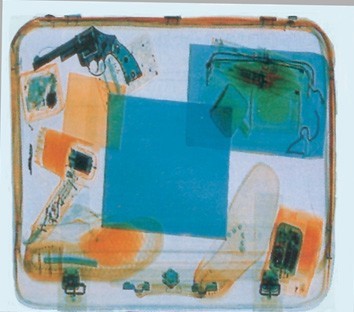
Example 1
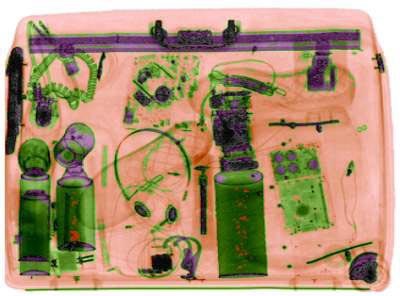
Example 2
Objects:
After being able to separate the materials by looking at the colors, the rest lies in locating and seeing the outline of the object you want to identify. If you look at the example above, the concept is pretty clear. To identify something on the airport x-ray images, you need to be able to see the outlines, even though the objects inside may be tilted at an odd angle, and the image of the object might be unusual. In Example 1, try to find the gun, and both shoes, the cologne and the other objects. Also, is there something strange about the shoes?
Once you have mastered the art of interpreting the colors and the outlines, there’s really only the practice that is left. A normal x-ray image interpreter, or an x-ray machine operator, will have approximately three weeks of practice and tests before going into the field, so to speak, and even then there’s about another month with someone hanging over his or her shoulder, making sure that everything is being done and seen correctly.
Colorful Differences
As you can see in example 2, the colors in airport security x-ray images will vary a little depending on the version of the machine, and most of all depending on the manufacturer. The fact is, however, that if you’ve managed to learn enough about the mechanics, the colors, the shapes and how the image is affected by how an object is placed on the conveyor, then these little differences will not even slow you down.
Computer-based X-ray image interpretation tests (Formative)
Computer-based X-ray image interpretation tests constitute a valuable tool for standardized measurements of X-ray image interpretation competency. These tests should consist of X-ray images of passenger bags containing different prohibited objects. The categories of items should reflect the prohibited items list and requirements of the appropriate authority, and it should be ensured that the test content remains up to date. The test should also contain clean bag images, that is, X-ray images of bags that do not contain a prohibited object. For each image, the screeners should indicate whether or not a prohibited object is present. Additionally, the screeners can be requested to identify the prohibited item(s). The image display duration should be comparable to operational conditions.
Requirements for Assessing Competency
One of the most important tasks of an aviation security screener is the interpretation of X-ray images of passenger bags and the identification of prohibited items within these bags. Hit rates, false alarm rates, and the time used to visually inspect an X-ray image of a passenger bag are important measures that can be used to assess the effectiveness of screeners at this task. A hit refers to detecting prohibited items in an X- ray image of a passenger bag. The hit rate refers to the percentage of all X-ray images of bags containing a prohibited item that are correctly judged as being NOT OK. If a prohibited item is reported in an X-ray image of a bag that does not contain such an item, this counts as a false alarm. The false alarm rate refers to the percentage of all harmless bags (i.e., bags not containing any prohibited items) that are judged by a screener as containing a prohibited item. The time taken to process each bag is also important, as it helps in determining throughput rates and can indicate response confidence. The results of an X-ray image interpretation test provide very important information for civil aviation authorities, aviation security institutions, and companies. Moreover, failing a test can have serious consequences, depending on the regulations of the appropriate authority. Therefore, it is essential that a test should be fair, reliable, valid, and standardized. In the last 50 years, scientific criteria have been developed that are widely used in psychological testing and psychometrics. These criteria are essential for the development of tests for measuring human performance.
Certification of X-Ray Image Interpretation Competency
As indicated above and as specified in ICAO Annex 17, 3.4.3, individuals carrying out Screening operations should be certified initially and periodically thereafter.
Certification can not only be considered as providing quality control over the screening process; but also as a valuable basis for awarding personnel a qualification, measuring training effectiveness, improving training procedures, and increasing motivation.
Certification data provides important information on strengths and weaknesses in aviation security procedures in general as well as on individual screeners. Furthermore, standardized certification can help in achieving international standardization in aviation security. However, this is very challenging, since many countries, organizations, and companies develop their own certification and quality control systems. The present section gives a brief overview of how a certification system can be implemented. As mentioned above, certification of screeners should contain a theoretical exam and an X-ray image interpretation exam.
Considered necessary, unlike the initial certification, where practical exams are required. The exams should meet the requirements of high reliability and validity and standardization (see above).The X-ray image interpretation exam should be adapted to the domain in which a screener is employed, that is, cabin baggage screening, hold baggage screening, or cargo screening. Since not every threat object always constitutes a threat during the flight, depending on where aboard the aircraft it is transported, screeners should be certified according to their domain. The certification of cabin baggage screeners should be based on cabin baggage X-ray images that contain all kinds of objects that are prohibited from being carried on in cabin baggage (guns, knives, improvised explosive devices, and other prohibited items). Objects that are prohibited from being transported in the cabin of an aircraft do not necessarily pose a threat when transported in the hold or in cargo. Furthermore, different types of bags are transported in the cabin, the hold, and cargo. Usually, small suitcases or bags serve as hand baggage, whereas big suitcases and traveling bags are transported in the hold of the aircraft. The certification of hold baggage screeners should be conducted using X- ray images of hold baggage. Similarly, cargo screeners should be tested using X-ray images of cargo items. Screeners should be kept up to date regarding new and emerging threats. In order to verify whether this is consistently achieved, it is recommended that a recurrent certification should be conducted on a periodical basis, typically every 1-2 years. The minimum threshold that should be achieved in the tests in order to pass certification should be defined by the national appropriate authority and should be based on a large and representative sample of screeners (see also the section on standardization for more information on this topic)
This section introduces the X-Ray Competency Assessment Test (X-Ray CAT) as an example of a computer-based test that can be used for assessing X-ray image interpretation competency.
The CAT has been developed on the basis of scientific findings regarding threat detection in X-ray images of passenger bags. How well screeners can detect prohibited objects in passenger bags is influenced in two different ways. First, it depends on the screener’s knowledge of what objects are prohibited and what they look like in X-ray images.
This knowledge is an attribute of the individual screener and can be enhanced by specific training. Second, the probability of detecting a prohibited item in an X-ray image of a passenger bag also depends on image-based factors. These are the orientation of the prohibited item within the bag (view difficulty), the degree by which other objects are superimposed over an object in the bag\ (superposition), and the number and type of other objects within the bag (bag complexity). Systematic variation or control of the image-based factors is a fundamental property of the test and has to be incorporated in the test development.
In the X-Ray CAT, the effects of viewpoint are controlled by using two standardized rotation angles in an ‘easy’ and a ‘difficult’ view for each forbidden object.
Superposition is controlled in the sense that it is held constant over the two views and as far as possible over all objects. With regard to bag complexity, the bags are chosen in such a way that they are visually comparable in terms of the form and number of objects with which they are packed.
The X-Ray CAT contains two sets of objects in which object pairs are similar in shape. This construction not only allows the measurement of any effect of training, that is, if detection performance can be increased by training, but also possible transfer effects.
The threat objects of one set can then be included in the training. By measuring detection performance after training using both sets of the test, it can be ascertained whether training also helped in improving the detection of the objects that did not appear during training. Should this be the case, it indicates a transfer of the knowledge gained about the visual appearance of objects used in training to similar-looking objects.
Materials for the test
Stimuli were created from colour X-ray images of prohibited items and passenger bags (Figure 2 displays an example of the stimuli).
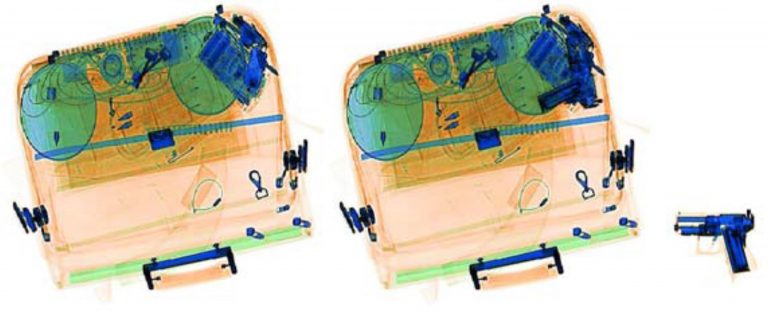
On the basis of the categorization of current threat image projection systems, four categories of prohibited items were chosen to be included in the test: guns, improvised explosive devices (IEDs), knives, and other prohibited items (e.g., gas, chemicals, grenades, etc.). The prohibited items were selected and prepared in collaboration with airport security experts to be representative and realistic. Sixteen exemplars are used of each category (eight pairs). Each pair consists of two prohibited items of the same kind that are similar in shape. The pairs were divided into two sets, set A and set B. Furthermore, each object within both sets is used in two standardized viewpoints (see Figure 3). Figure 3 (Prohibited Item Screen Projection.) Example of two X-ray images of similar looking threat objects used in the test. Left: a gun of set A. Right: Corresponding gun of set B. Both objects are depicted also in 85 degree horizontal rotation (top) and 85 degree vertical rotation (bottom). Figure 2 (Prohibited Item Identification.) Example images from the X-Ray CAT. Left: harmless bag (non-threat image), right: same bag with a prohibited item at the top right corner (threat image). The prohibited item (gun) is also shown separately at the bottom right.

